An acid-base titration
is when you add a base to an acid until the equivalence point is
reached which is where the number of moles of acid equals the number of
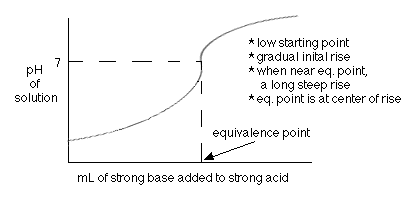
moles of base. For the titration of a strong base and a strong acid,
this equivalence point is reached when the pH of the solution is seven
(7) as seen on the following titration curve:
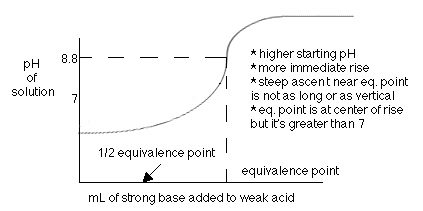
For the titration of a strong base with a weak acid, the equivalence point
is reached when the pH is greater than seven (7). The half equivalence
point is when half of the total amount of base needed to neutralize the
acid has been added. It is at this point where the pH = pKa of
the weak acid.
In an acid-base titration, the base will react with the weak acid and
form a solution that contains the weak acid and its conjugate base until
the acid is completely gone. To solve these types of problems, we will
use the Ka value of the weak acid and the molarities in a similar way as we have before. Before
demonstrating this way, let us first examine a short cut, called the
Henderson-Hasselbalch Equation. This can only be used when you have
some acid and some conjugate base in your solution. If you only have acid, then you must do a pure Ka problem and if you only have base (like when the titration is complete) then you must do a Kb problem.
pH =pKa + log
[base] [acid]
Where:
pH is the log of the molar concentration of the hydrogen
pKa is the equilibrium dissociation constant for an acid
[base] is the molar concentration of a basic solution
[acid] is the molar concentration of an acidic solution
Example Problem: 25.0 mL of 0.400 M KOH is added to 100. mL of 0.150 M benzoic acid, HC7H5O2 (Ka=6.3x10⁻⁵). Determine the pH of the solution.
Answer:
Determine where in the titration we are:
0.400 M x 0.025 L = 0.0100 mol KOH added
0.150 M x 0.100 L = 0.0150 mol HC7H5O2 originally
because only 0.100 mol of base has been added, that means the thitration is not complete; this means there are two ways to solve this problem: the normal way and the way using the Henderson-Hasselbalch Equation.
Normal way:
HC7H5O2
+
OH-
C7H5O2-
+
H2O
before reaction:
0.015 mol
0.0100 mol
0 mol
--
change:
-0.0100
-0.0100
+0.0100
--
after reaction:
0.0050
0
0.0100
--
Ka =
[H+][C7H5O2-] [HC7H5O2]
= 6.3x10-5 =
(x)(0.0100) 0.0050
x = [H+] = 3.2x10⁻⁵ M
pH = -log(3.2x10⁻⁵) = 4.49
Henderson-Hasselbalch Way:
[HC7H5O2] =
0.0050 mol 0.125 L
= 0.040 M
[C7H5O2-] =
0.0100 mol 0.125 L
= 0.0800 M
pH = pKa + log
[base] [acid]
pH = -log(6.3x10⁻⁵) + log
0.0800 0.0400
= 4.20 + 0.30 = 4.50
This equation is used frequently when trying to find the pH of buffer solutions. A buffer solution is one that resists changes in pH upon the addition of small amounts of an acid or a base. They are made up of a conjugate acid-base pair such as
HC2H3O2/C2H3O2- or NH4+/NH3. They work because the acidic species neutralize the OH- ions while the basic species neutralize the H+ ions. The buffer capacity is the amount of acid or base the buffer can neutralize before the pH begins to change to a significant degree. This depends on the amount of acid or base in the buffer. High buffering capacities come from solutions
with high concentrations of the acid and the base and where these concentrations are similar in value.
Practice weak acid problem:
C6H5COONa is a salt of a weak acid C6H5COOH. A 0.10 M solution of C6H5COONa has a pH of 8.60.
When forming compounds, it is important to know something about the way
atoms will react with each other. One of the most important manners in
which atoms and/or molecules react with each other is the
oxidation/reduction reaction. Oxidation/Reduction reactions are the
processes of losing and gaining electrons respectively. Just remember, "LEO the lion says GER:" Lose Electrons Oxidation, Gain Electrons Reduction.
Oxidation numbers are assigned to atoms and compounds as a way to tell
scientists where the electrons are in a reaction. It is often referred
to as the "charge" on the atom or compound. The oxidation number is
assigned according to a standard set of rules. They are as follows:
An atom of a pure element has an oxidation number of zero.
For single atoms in an ion, their oxidation number is equal to their charge.
Fluorine is always -1 in compounds.
Cl, Br, and I are always -1 in compounds except when they are combined with O or F.
H is normally +1 and O is normally -2.
The oxidation number of a compound is equal to the sum of the oxidation numbers for each atom in the compound.
Knowing the oxidation number of a compound is very important when
discussing ionic compounds. Ionic compounds are combinations of
positive and negative ions. They are generally formed when nonmetals and
metals bond. To determine which substance is formed, we must use the
charges of the ions involved. To make a neutral molecule, the positive
charge of the cation (positively-charged ion) must equal the negative
charge of the anion (negatively-charged ion). In order to create a
neutral charged molecule, you must combine the atoms in certain
proportions. Scientists use subscripts to identify how many of each
atom makes up the molecule. For example, when combining magnesium and
nitrogen we know that the magnesium ion has a "+2" charge and the
nitrogen ion has a "-3" charge. To cancel these charges, we must have
three magnesium atoms for every two nitrogen atoms:
3Mg2+ + 2N3- --> Mg3N2
Knowledge of the charges of ions is crucial to knowing the formulas of the compounds formed.
alkalis (1st column elements) form "+1" ions such as Na+ and Li+
alkaline earth metals (2nd column elements) form "2+" ions such as Mg2+ and Ba2+
halogens (7th column elements) form "-1" ions such as Cl- and I-